
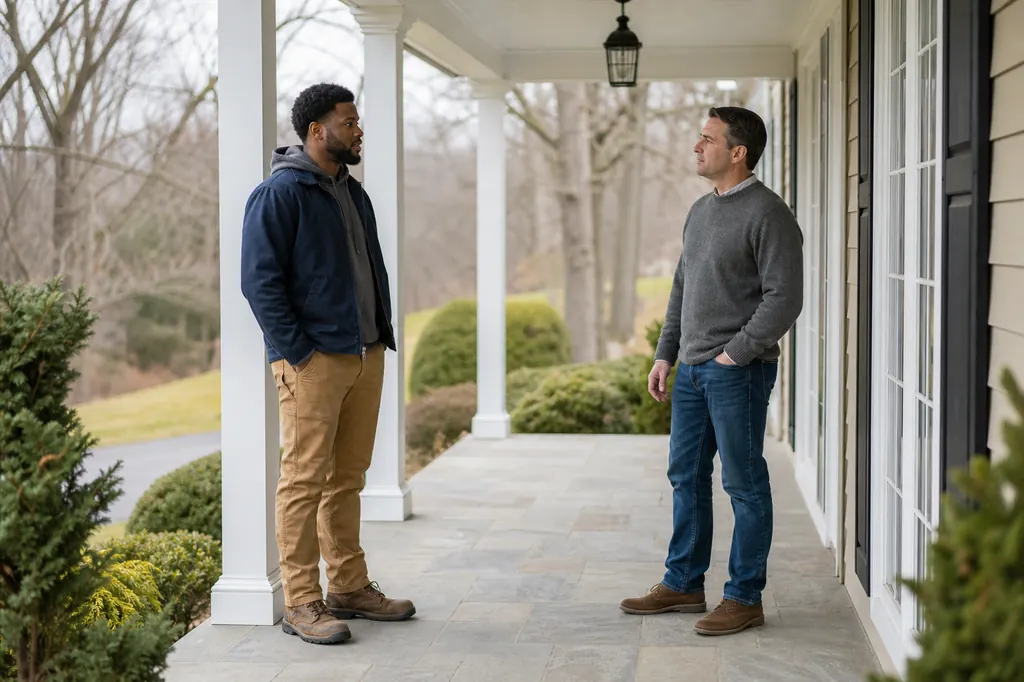
Photo: illustrative image created with AI.
Agree on the next step before you leave the estimate, then have one named person keep that promise. Each follow-up should bring something useful, such as an answer or an honest schedule update, and give the customer an easy way to say no. Stop when they decline or ask you to, and after your last planned message.
Follow-up often feels like pressure because it's a surprise. A homeowner who said "we'll talk it over" and then gets three "just checking in" texts feels chased. The same homeowner, told "I'll call Friday after you've spoken with your son," is getting a call they expected.
Ask one question before you leave
Try "When would it be useful for me to get back to you, and what's the best way?" Then write down the answer, along with whoever else is deciding. On a walk-in shower for an older parent, that may be a daughter who wasn't in the room. With windows, it may be a spouse who wants to see the lower-priced option. A standby generator quote might wait on the gas company or the household budget.
Those are three different follow-ups. If all the office gets is a PDF and a total, it can only send the same nag to each of them.
Ask permission for the channel while you're there, especially for texts. A phone number on a form tells you how to reach someone. It doesn't tell you what they agreed to receive.
One owner, with a backup
The person who built the quote is usually the best one to discuss it, because they know why the panel has to move or why that window costs more. The office can own the reminder, the paperwork and the appointment. What doesn't work is both of them assuming the other called.
Hand over a record the backup could act on while the estimator is in an attic:
- the scope, the options quoted and any date the price runs out
- who decides, how they want to be contacted and what they agreed to
- the open question, in the customer's words
- the next action, with a name and a date
- the source of the lead, including any tracking number, so a sale or loss finds its way back to the marketing
A spreadsheet can hold that. So can a CRM, the customer database in many field-service programs. Either is fine if no open quote can exist without a next date. If customer replies go to a personal phone, decide who sees them during a vacation or after hours.
How long should you wait? An example to edit
There's no proven schedule for every trade. Use the date the customer gave you. When there isn't one, start with something like this and change it to suit how long your buyers take.
| When | Who | Purpose |
|---|---|---|
| Day the estimate goes out | Estimator | Confirm it arrived and repeat the agreed next step |
| Two or three working days later | Estimator | Answer the question they left open |
| About a week after that | Office | Offer the missing item, a revised option or a real schedule update |
| The date they named, or the end of your window | Estimator | Ask for yes, no or later, then close or park the quote |
A water heater that's already leaking compresses all of that into a day. A spring bathroom project may need one call now and one in February, if February is when they asked you to call. You may have read about a five-minute rule for leads. That advice is about the first response to a new inquiry. It's no reason to call five minutes after someone receives a big quote.
Example messages you can make your own
These are examples with made-up names, written for a person to send. Change the facts and the voice before you use them.
The estimate just went out
"Hi Dana, it's Luis, who measured your windows. I emailed the estimate with both options. You mentioned talking with Chris this weekend, so I'll call Monday unless another day is better."
Someone else is helping decide
"Mrs. Lee, you asked me to include your daughter. With your okay, I can send her the same drawing and go over it with both of you. If you'd prefer I didn't, that's completely fine."
That last sentence matters on aging-in-place work. The parent is your customer until they tell you otherwise, so don't go around them to the adult child.
The decision is waiting on something
"Hi Pat, it's Ana about the generator. You were waiting to hear about the gas service. Did you get what you needed, or is there a question I should take? If the project is on hold, tell me and I'll stop following up."
The last message
"Hi Sam, I haven't heard back, so I'll close the estimate for now. No need to explain. If the project comes back, reply here and I'll check whether the price and schedule still stand."
Skip deadlines you made up, discounts that appear on the second call and claims that the calendar is filling when it isn't. If a manufacturer's price really changes Friday, say that once. For generators, be especially careful not to lean on the next storm. Our guide to marketing generators before storm season handles timing well before the quote.
Write the stop rules down
Stop on no, on "don't contact me," and when the job sells or you find you can't do it. Pause when they give you a later date, or when the customer has something going on at home that clearly outranks your quote. If there's been a death in the family, cancel the scheduled reminder. Automated reminders have to stop on the same signals, so a reply must reach a person who can switch them off.
Once a contract is signed, don't talk anyone out of cancelling. Under New Jersey law (N.J.S.A. 56:8-151), a consumer can cancel a home improvement contract until midnight of the third business day after receiving a copy.
The rules around texts, calls and email
This is general information, not legal advice. Have your own process checked, particularly if software does the sending.
Texts
An advertising text is different from an answer to a customer's question. New Jersey requires permission that includes the mobile number before an unsolicited advertising text (N.J.S.A. 2A:65D-3), and the person can withdraw it. Carriers also look to industry guidance that expects agreement for informational texts and written agreement for promotional ones. Adding a coupon to a reminder can turn it promotional.
Federal rules for covered automated calls and texts change on November 25, 2026. Through November 24, customers can opt out by any reasonable method. From November 25, a sender may name certain methods, such as replying STOP, as the only ones if the message or call says so. An opt-out from a marketing message also ends consent for all that company's future marketing calls and texts covered by the rule. Both versions allow no more than ten business days to honor it. We'd stop right away when the meaning is clear, whatever words they used.
Sales calls
Asking for an estimate doesn't open the door forever. For a number on the National Do Not Call Registry, the exemption for an inquiry lasts three months and ends sooner if the person asks you not to call, so a November estimate may not cover a March call.
New Jersey adds its own rules for unsolicited sales calls. They require state registration, restrict calls to cell phones and bar calls from 9 p.m. to 8 a.m. (N.J.S.A. 56:8-121, 56:8-128 and 56:8-130). A call made in response to the customer's express written request isn't treated as unsolicited (56:8-120). An unsold estimate doesn't clearly make someone an existing customer, so get that request in writing at the visit.
A promotional email needs a postal address and a working opt-out, honored within 10 business days.
Record why you lost
"Price" is often what gets typed when nobody asked. Keep a short list: chose another company, scope changed, postponed, couldn't meet the date, outside our area, no response, and price with a note about what was compared. Record "no response" when that's all you know.
Before you change anything, count open quotes by age and how many have a next step. Repeat the count after the new process has run for a full decision period. That shows whether follow-up is happening. Whether it wins more work will also depend on price, scope and who was asking, so don't credit the messages for all of it.
Have the handoff looked at
With sales growth support, we assess the process and recommend changes. Your team keeps the customer conversations. If you can't tell whether the leak is here or earlier, start with where leads stop becoming booked jobs. To go through yours, request a free 20-minute growth conversation and bring a few aged estimates with private details removed, the current reminder wording and the name of whoever owns the next call.
Sources
- P.L.2023, c.237: home improvement and home elevation contractors, New Jersey Legislature. Checked November 22, 2026.
- P.L.2015, c.119: unsolicited advertising by text messaging (N.J.S.A. 2A:65D-1 to 2A:65D-5), New Jersey Legislature. Checked November 22, 2026.
- Messaging Principles and Best Practices, CTIA. Checked November 22, 2026.
- Enhancing the Ability of Consumers To Control the Robocalls (91 FR 67214), Federal Register / FCC. Checked November 22, 2026.
- Q&A for Telemarketers & Sellers About DNC Provisions in TSR, Federal Trade Commission. Checked November 22, 2026.
- CAN-SPAM Act: A Compliance Guide for Business, Federal Trade Commission. Checked November 22, 2026.
- P.L.2015, c.2: unsolicited telemarketing sales calls to mobile phones, New Jersey Legislature. Checked November 22, 2026.
- P.L.2003, c.208: telemarketing sales call definitions and rules, New Jersey Legislature. Checked November 22, 2026.
- P.L.2003, c.76: unsolicited telemarketing sales calls, New Jersey Legislature. Checked November 22, 2026.
- P.L.2023, c.58: requirements for telemarketing sales calls, New Jersey Legislature. Checked November 22, 2026.